Telehandlers can lift huge loads, but only within strict limits and misreading a load chart can lead to costly, even dangerous, mistakes. Every telehandler comes with a unique load chart that changes with boom angle, extension, and attachment.
Have you ever seen an operator guess whether a load was safe to lift? Or extend the boom a little too far and feel the whole machine shift? That’s what load charts are meant to prevent.
Here’s how to read them properly, and why understanding load charts is a non-negotiable part of safe telehandler operation.
Why Load Charts Matter
Load charts define the maximum weight a telehandler can lift safely at different:
- Boom lengths and angles
- Heights and outreach distances
- Attachment types
- Ground conditions (flat, sloped, stabilised)
Misjudging these factors leads to:
- Machine tip-overs
- Overloaded booms or cracked frames
- Legal liability for non-compliant lifting
“How Do You Read a Telehandler Load Chart?”
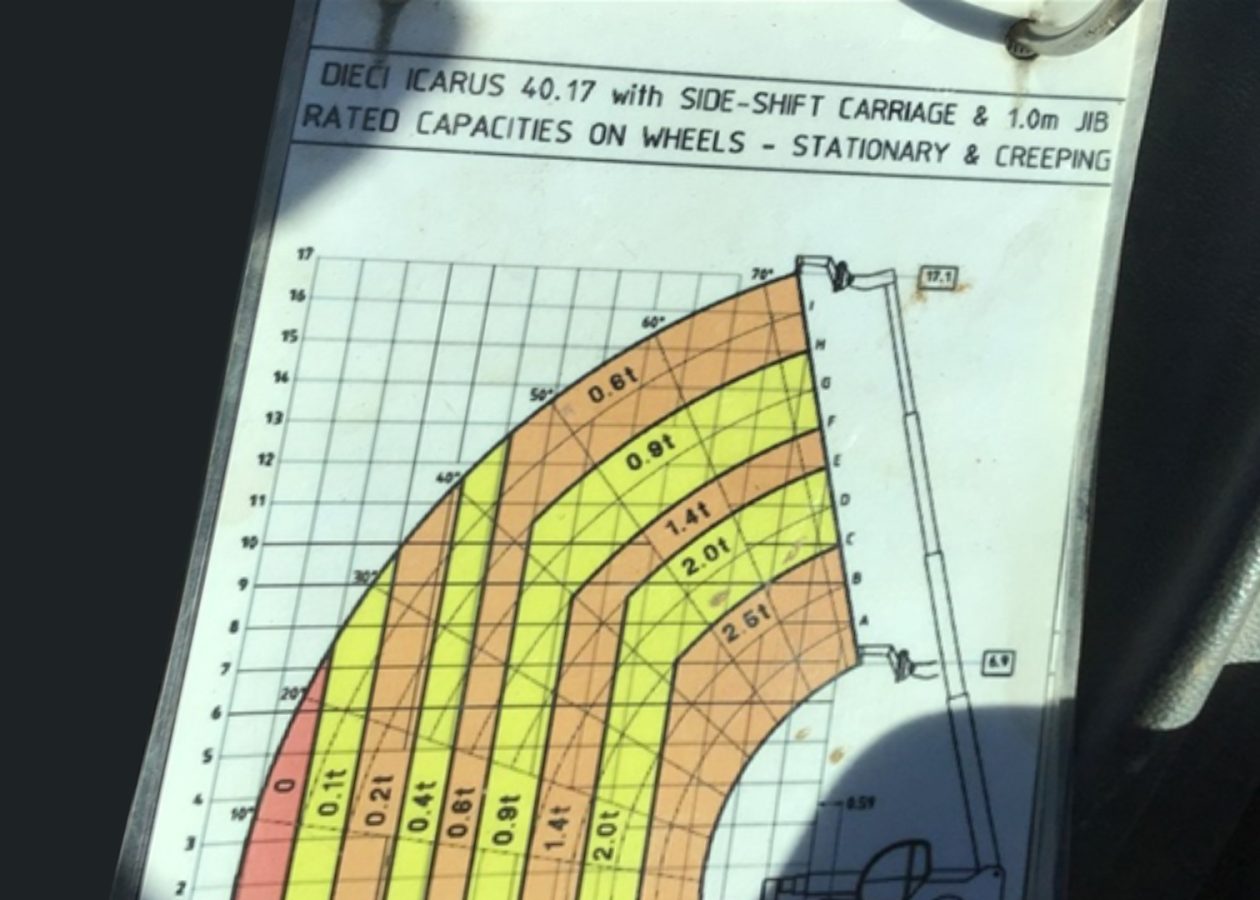
To read a telehandler load chart:
- Find the boom angle and extension distance
- Match that point on the grid to the rated lifting capacity
- Check if stabilisers or specific attachments are required
Never guess, always use the exact chart for your machine and tool.
Key Sections of a Telehandler Load Chart
- Boom Angle / Reach Graph
- Often displayed as a grid or graph
- X-axis = horizontal reach
- Y-axis = height or boom angle
- Often displayed as a grid or graph
- Lifting Capacities by Distance
- Rated in kilograms or tonnes
- May have shaded areas for restricted zones
- Rated in kilograms or tonnes
- Attachment Icons or Zones
- Different tools change capacity
- Forks, jibs, baskets, buckets all have separate ratings
- Different tools change capacity
- Stabiliser Requirements
- Some lifts are only safe with outriggers extended
- Load chart will indicate when stabilisation is mandatory
- Some lifts are only safe with outriggers extended
- Notes and Warnings
- Includes slope limits, wind load effects, and safety margins
Practical Example: Reading a Load Chart
Let’s say your machine has:
- A 14m boom
- A pallet fork attachment
- You’re lifting at a 45° angle and 10m reach
You’d find the point on the chart where 10m outreach intersects with the 45° boom angle, then read the capacity listed e.g., 1,200 kg. If your load is 1,300 kg, the lift isn’t safe.
Mistakes Operators Often Make
- Using the wrong chart (e.g., for a different attachment)
- Assuming flat ground when operating on a slope
- Overreaching at height without compensating for angle
- Forgetting to adjust for wet or unstable terrain
- Misjudging load shape or wind resistance (especially for sheets or pallets)
Tips to Train Better Load Chart Awareness
- Review charts during every pre-start
- Keep laminated copies in the cab
- Run mock lift scenarios during VOC or refreshers
- Use stickers or quick-reference cards near controls
How Dieci Supports Load Safety
Dieci Australia:
- Supplies model-specific load charts with every machine
- Provides operator training on chart interpretation
- Ensures attachments are rated and matched to each machine
- Offers quick-hitch systems with auto-recognition for safety
Advanced machines feature onboard digital load indicators for real-time feedback.
Final Thoughts: Confidence Comes from Clarity
What would change if every operator on your site knew exactly what they could (and couldn’t) lift at every boom angle, every height, and with every attachment?
Load charts aren’t just paperwork. They’re essential safety systems. Understand them, and you’ll avoid unnecessary risks while boosting productivity.
Need help training your team on safe load handling? Contact Dieci Australia for machine-specific charts, operator refreshers, and attachment safety support.