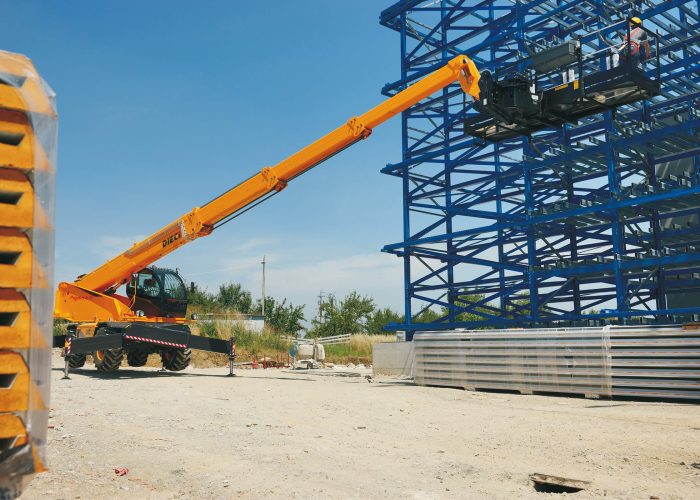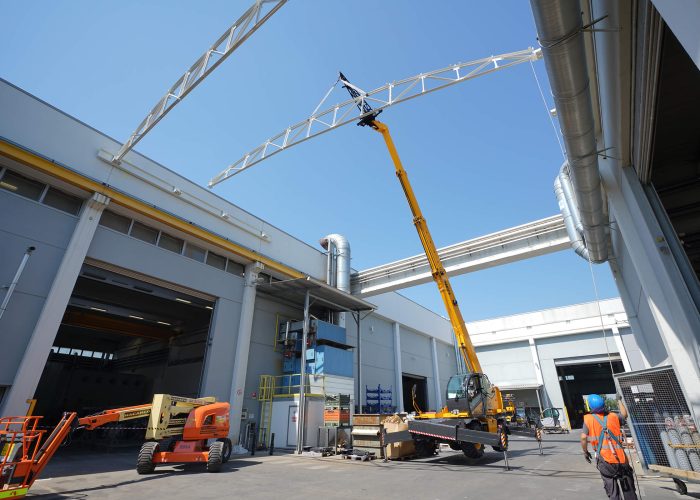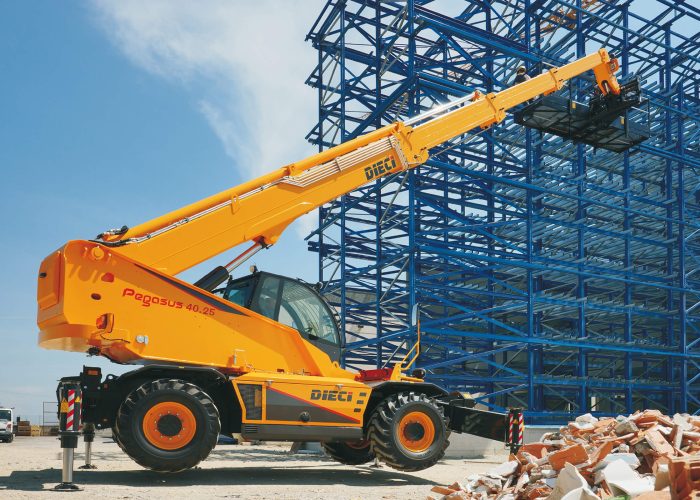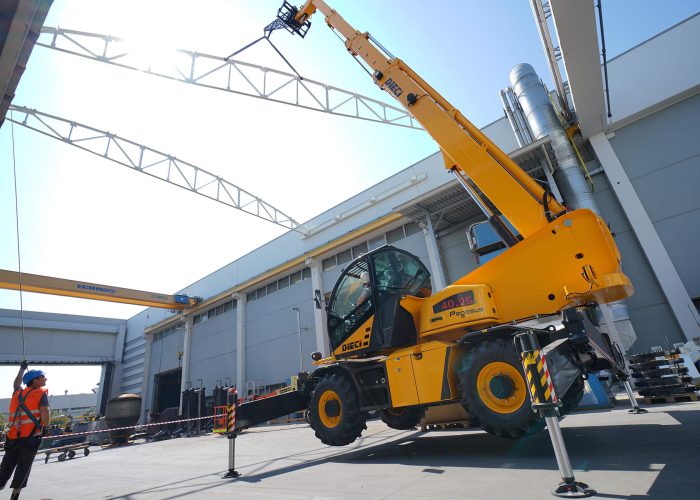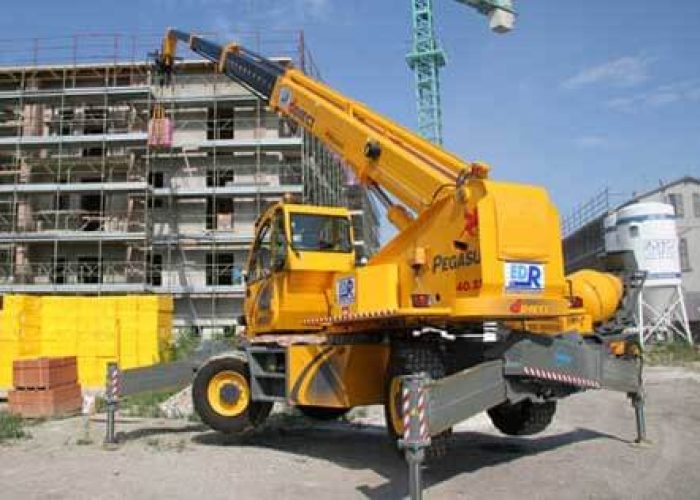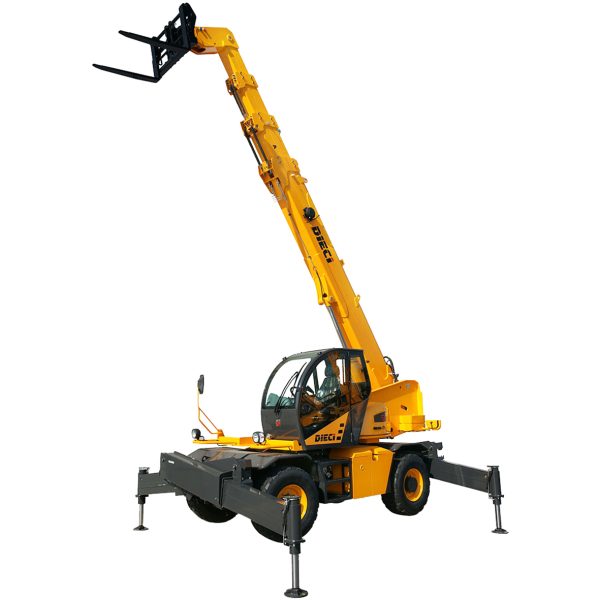
The Pegasus 360 40.25 4t rotating telehandler stands out as a rotational telehandler, offering 360° continuous rotations. Renowned for its exceptional versatility, it accommodates a wide range of attachments, enabling it to function seamlessly as a telehandler, aerial platform and crane in various applications.
Key attributes of this model include user-friendliness, robustness and a comprehensive array of safety features, including a load limiter and cutting-edge equipment for precise control over the vehicle in diverse conditions of effort, load, terrain and speed.
Featuring outriggers with automatic levelling function and an electric control system utilising CANBUS technology for operation in any position, this model also includes a load sensing and flow sharing hydraulic distributor and a new rotary joint with integrated rotation sensor.
Dieci Australia offers a complete range of telehandlers, rotational telehandlers, mixer trucks and dumper trucks for sale in Australia
Contact Dieci Australia for more information.
Request a Follow-up From Your Local Dieci Sales Team
Pegasus 360° 40.25 | 4t Rotating Telehandler Frequently Asked Questions
What is a rotational telehandler?
A rotational telehandler, such as the Dieci Pegasus 360 40.25, features a turret-mounted boom capable of 360-degree continuous rotation, allowing loads to be lifted and positioned anywhere around the machine without the need to reposition the chassis. This continuous rotation capability provides exceptional flexibility compared to a conventional telehandler and enables a single machine to perform the roles of a telehandler, crane, and elevated work platform when equipped with the appropriate attachments.
The fully rotating upper structure makes rotational telehandlers particularly well suited to construction, industrial, and maintenance applications where access is restricted or precise load placement is essential. By minimising the need for repeated machine movements and allowing operators to work over a full 360-degree radius, a rotational telehandler can improve productivity, enhance safety, and maximise efficiency on busy worksites.
What is the difference between a 360° and 400° rotation telehandler?
The key advantage of the Dieci Pegasus 360 40.25 lies in its 360-degree continuous rotation system. Unlike non-continuous rotating telehandlers, which eventually reach a stop point and must reverse direction, the Pegasus 360 40.25 can rotate endlessly in either direction without interruption. This allows operators to maintain smooth, continuous movements when lifting and positioning loads around the machine.
The continuous rotating turret provides exceptional flexibility for construction, industrial, and maintenance applications where multiple lifts are required over a wide working area. By eliminating the need to reposition the chassis or reverse turret direction, the Pegasus 360 40.25 enables faster cycle times, improved precision, and greater productivity. Combined with the ability to operate as a telehandler, crane, or elevated work platform with the appropriate attachments, 360-degree continuous rotation helps maximise efficiency on busy worksites.
What tasks would a rotational telehander be used for?
Rotational telehandlers are used for a wide range of lifting and access tasks where flexibility and precise load placement are essential. Common applications include structural steel erection, precast concrete installation, roofing and cladding work, material handling on multi-storey construction sites, and lifting equipment into hard-to-reach areas. With the appropriate attachments, a rotational telehandler can also be used as a crane for suspended loads or fitted with a work platform for safe elevated access.
The Dieci Pegasus 360 40.25 6 features a 360-degree continuous rotating turret, allowing operators to lift and position loads over a wide working area without constantly repositioning the chassis. This makes it particularly valuable on congested sites where access is limited and precise load placement is required. By combining the capabilities of a telehandler, crane, and elevated work platform in a single machine, a rotational telehandler can improve productivity, reduce equipment requirements, and lower overall project costs.
What is the maximum lift height of the Pegasus 360° 40.25 telehandler?
With a maximum lift height of 24.1 metres and a continuously rotating turret, the Pegasus 360° 40.25 telehandler is ideally suited to a wide range of construction applications. Common uses include structural steel erection, where beams, columns, and roof trusses can be accurately positioned without constantly moving the machine.
The machine is also highly effective for installing precast concrete panels, wall sections, and floor planks, as well as lifting roofing materials and cladding into place on multi-storey buildings. With approved work platforms, it can provide safe elevated access for façade installation, glazing, painting, maintenance, and inspection tasks.
On large commercial and industrial projects, a 24.1-metre rotational telehandler can be used to place generators, air-conditioning units, tanks, and other plant equipment onto rooftops or upper levels. Its combination of telehandler, crane, and elevated work platform capabilities allows a single machine to perform multiple roles, improving productivity and reducing the need for additional equipment on site.
What steering modes does the Pegasus 360° 40.25 telehandler have?
The Dieci Pegasus 360° 40.25 telehandler is equipped with three steering modes; two-wheel steer, four-wheel steer, and crab steer which provide the versatility required to operate efficiently across demanding Australian construction and infrastructure projects.
Two-wheel steer delivers stable handling and is ideal for travelling longer distances around site and transporting heavy loads between work areas. Four-wheel steer significantly reduces the turning radius, allowing operators to manoeuvre the telehandler more effectively in confined spaces such as structural steel erection zones, precast yards, and busy construction sites.
Crab steer enables the front and rear wheels to turn in the same direction, allowing the machine to move diagonally. This mode is particularly valuable when positioning large beams, precast concrete elements, pipework, and modular building components alongside structures or within restricted work areas. The result is more precise load placement, improved control, and fewer machine repositioning movements, helping to increase productivity on site.
What engine powers the Pegasus 360° 40.25 telehandler?
The Dieci Pegasus 360° 40.25 telehandler is equipped with a 107 kW (143 hp) FPT diesel engine. The turbo charged engine meets strict Stage IIIA / Tier 3 emissions standards, resulting in a reliable and efficient rotational telehandler that is well suited to the tough conditions found on construction, civil, and infrastructure projects.