For decades, diesel has been the standard power source for telehandlers. They have the power, versatility and durability needed to handle demanding construction, infrastructure, industrial and agricultural applications.
But the way we work is changing.
More projects are taking place in urban environments, enclosed spaces and areas where noise, exhaust emissions and environmental impact are becoming increasingly important considerations. At the same time, businesses are looking more closely at operating costs, maintenance requirements and the total cost of owning and operating their machinery.
For many applications, electric telehandlers now provide a genuine alternative to diesel – without sacrificing the lifting capability or versatility that operators expect.
The Dieci Apollo-e 26.6 is a prime example, combining a 2.6-tonne lifting capacity and 5.73-metre maximum lift height with fully electric operation in a compact and highly manoeuvrable package.
1. Zero exhaust emissions
One of the most obvious advantages of moving from diesel to electric is the elimination of tailpipe emissions.
The Apollo-e 26.6 produces zero exhaust emissions during operation, making it particularly well suited to enclosed and environmentally sensitive locations.
For indoor applications, this can be a significant advantage. Warehouses, workshops, manufacturing facilities and other enclosed environments can benefit from removing diesel exhaust from the workplace.
It can also make electric equipment an attractive option for urban construction and projects where environmental requirements or site restrictions place greater emphasis on emissions.
Instead of running a diesel engine and managing exhaust fumes, an electric telehandler can carry out the same essential material-handling tasks without producing exhaust at the point of use.
2. A much quieter working environment
Noise is another major difference between diesel and electric machinery.
Diesel engines generate continuous engine noise, particularly when the machine is working hard or maintaining engine speed for hydraulic functions. An electric drivetrain operates significantly more quietly.
The Apollo-e 26.6’s quiet electric drivetrain makes it particularly suitable for warehouses, urban construction, commercial developments, residential projects and other noise-sensitive environments.
Lower operating noise can also make communication easier between operators and other workers on busy sites.
For businesses operating machinery inside buildings or close to the public, neighbouring properties or occupied buildings, reducing machinery noise can be a major practical benefit.
3. Lower routine maintenance requirements
Electric machinery doesn’t have a diesel engine, which means there is no engine oil, fuel system, exhaust system or many of the other components associated with conventional diesel engine servicing.
That can simplify routine maintenance and potentially reduce maintenance costs and downtime over the life of the machine.
Dieci’s Apollo-e 26.6 electric telehandler uses separate electric motors for traction and hydraulic functions, rather than relying on a conventional diesel engine to provide power for both. The machine uses a 19 kW traction motor and a 22 kW hydraulic system motor.
Fewer engine-related service requirements can be particularly attractive for businesses and hire fleets looking to improve machine availability and control whole-of-life operating costs.
Of course, electric machinery isn’t maintenance-free. Batteries, electric motors, hydraulics, tyres, brakes and other components still require appropriate inspection and servicing. However, eliminating the conventional diesel engine removes a substantial number of routine engine-related maintenance tasks.
4. Efficient power delivery
One of the biggest misconceptions about electric construction equipment is that electric means less capable.
In practice, electric motors have characteristics that can be particularly useful for material-handling equipment.
Electric motors deliver torque immediately, providing smooth and responsive power without the need to build engine RPM in the same way as a diesel machine.
The Apollo-e 26.6 uses dedicated electric motors for traction and hydraulic operation. This allows the machine to provide smooth drive performance while maintaining hydraulic capability for lifting and boom functions.
For operators, that translates into precise control when positioning loads, manoeuvring in confined spaces and carrying out repetitive material-handling tasks.
5. Excellent manoeuvrability in confined spaces
Going electric doesn’t mean giving up the versatility that makes a telehandler useful.
The Apollo-e 26.6 has a compact footprint of approximately 4.1 metres long, 1.86 metres wide and 1.98 metres high, making it particularly well suited to restricted-access and low-clearance environments.
It also features 2-wheel steer, 4-wheel steer and crab steering modes, allowing operators to select the steering configuration that best suits the environment.
That makes the Apollo-e particularly useful for applications such as:
- Indoor construction
- Warehouses and industrial facilities
- Basement and multi-storey car park projects
- Urban construction sites
- Infrastructure and maintenance work
- Events and temporary works
- Environmentally sensitive projects
- Sites with restricted access or low overhead clearance
Its compact dimensions and steering flexibility allow operators to work in locations where a larger telehandler may be difficult or impractical to use.
6. No compromise on lifting capability
Switching from diesel to electric doesn’t mean moving to a machine that is only suitable for light-duty work.
The Apollo-e 26.6 has a maximum lifting capacity of 2,600 kg and a maximum lift height of 5.73 metres, giving it the capability required for a wide range of everyday material-handling applications.
With a range of compatible attachments, the machine can be configured for different jobs, including pallet handling, buckets, lifting hooks, grippers, winches and access platforms.
This versatility allows businesses to use one compact machine for a variety of applications rather than requiring separate equipment for every task.
7. Flexible charging options
For businesses considering the move from diesel to electric, charging is naturally one of the biggest questions.
The Apollo-e 26.6 has been designed with charging flexibility in mind.
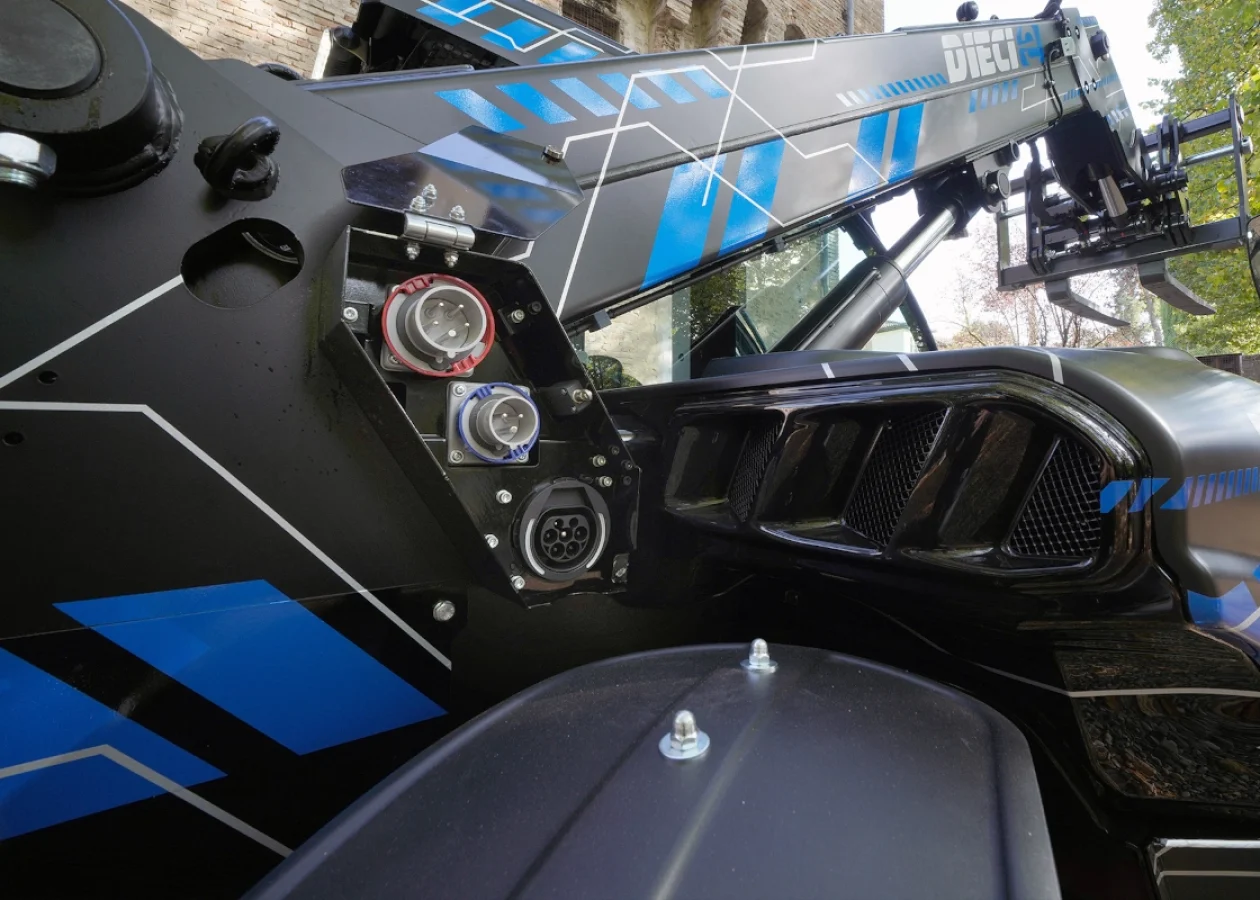
Depending on the configuration and power supply available, the machine can be charged using 240V, 415V three-phase power, a Mode 3 Type 2 connection or an optional external fast charger.
Charging can therefore be incorporated into an existing operating schedule.
For example, a machine working throughout the day can be charged during planned downtime, overnight or during scheduled breaks. With the appropriate charging equipment and electrical supply, charging times can also be significantly reduced.
The Apollo-e also uses a modular battery system, allowing battery capacity to be configured according to the application and workload.
8. Potentially lower operating costs
Fuel is one of the ongoing costs associated with diesel machinery.
Electric equipment replaces diesel fuel consumption with electricity, creating the potential for lower energy costs depending on local electricity prices, machine utilisation and operating conditions.
There can also be savings associated with reduced routine engine maintenance.
For businesses running machinery regularly, these savings can become increasingly significant over the machine’s operating life.
It’s important to look beyond the initial purchase price when comparing diesel and electric machinery. The real comparison should consider the total cost of ownership, including energy, servicing, maintenance, downtime and machine utilisation.
9. Better suited to modern worksite requirements
The construction and materials-handling industries are increasingly operating in environments where traditional diesel equipment isn’t always the ideal choice.
Urban developments are taking place closer to homes and businesses. Warehouses and manufacturing facilities require indoor equipment. Infrastructure projects increasingly operate under strict environmental and site requirements.
Electric telehandlers provide another option for businesses that need to work in these environments.
The Australian Government’s energy guidance for the construction sector also identifies diesel use in construction machinery as a significant area of direct energy consumption, while highlighting opportunities to reduce diesel use and improve efficiency.
Electric doesn’t necessarily replace diesel for every application. Large-scale earthmoving, remote projects and extremely high-hour applications may still favour conventional diesel machinery.
But for the right application, electric can offer a combination of benefits that diesel simply cannot provide.
Is an electric telehandler right for your business?
The decision to switch from diesel to electric shouldn’t be based on one factor alone.
Consider:
Where will the machine operate?
If you regularly work indoors, in urban areas, around the public or in environmentally sensitive locations, electric operation can provide significant advantages.
How many hours will it work?
High-utilisation operations should consider energy costs, charging requirements, maintenance and total cost of ownership.
What infrastructure is available?
Understanding the available electrical supply and planning charging around your working day is essential.
What lifting performance do you need?
The Apollo-e 26.6 provides 2,600 kg of maximum lifting capacity and 5.73 metres of maximum lift height, making it suitable for a broad range of compact telehandler applications.
The future of telehandling is becoming electric
The move from diesel to electric isn’t simply about replacing an engine with a battery.
It’s about changing the way machinery operates.
With zero exhaust emissions, significantly reduced noise, lower routine engine-maintenance requirements, responsive electric power and flexible charging, electric telehandlers can provide real advantages in the right working environment.
The Dieci Apollo-e 26.6 demonstrates that an electric telehandler can still deliver the lifting capacity, reach, manoeuvrability and attachment versatility expected from a modern telehandler – while offering the additional benefits of electric operation.
For businesses looking to reduce emissions, improve working conditions or operate machinery in locations where diesel equipment isn’t ideal, switching to an electric telehandler could be a practical next step.
Want to find out whether the Dieci Apollo-e 26.6 is right for your application? Contact Dieci Australia to discuss your requirements.
Frequently Asked Questions About Telehandlers
What are the main benefits of switching from a diesel to an electric telehandler?
Electric telehandlers offer several advantages, including zero exhaust emissions, significantly reduced operating noise, lower routine engine-maintenance requirements and responsive electric power delivery. They can be particularly beneficial for indoor, urban and noise-sensitive applications where diesel equipment may be less suitable.
Can the Dieci Apollo-e 26.6 replace a diesel telehandler?
For many applications, yes. The Apollo-e 26.6 provides a 2,600 kg maximum lifting capacity and 5.73 m maximum lift height, making it suitable for a wide range of material-handling tasks. Whether it can replace a particular diesel telehandler depends on the required lifting capacity, reach, operating hours and working environment.
How do you charge the Dieci Apollo-e 26.6?
The Apollo-e 26.6 offers several charging options, including 240V and 415V three-phase power, as well as compatible Type 2 charging and optional fast-charging solutions. Charging can be incorporated into scheduled breaks, downtime or overnight operations depending on the available electrical supply and charger configuration.
Is an electric telehandler suitable for indoor use?
Yes. The absence of diesel exhaust emissions and significantly reduced operating noise makes the Apollo-e 26.6 particularly well suited to warehouses, workshops, industrial facilities, commercial developments, indoor construction and other enclosed environments.
Is an electric telehandler cheaper to operate than a diesel telehandler?
An electric telehandler can offer lower operating costs through reduced energy and routine engine-maintenance requirements. Actual savings depend on factors such as electricity and diesel prices, machine utilisation, charging infrastructure and operating conditions, so the best comparison is based on the machine’s total cost of ownership over its working life.