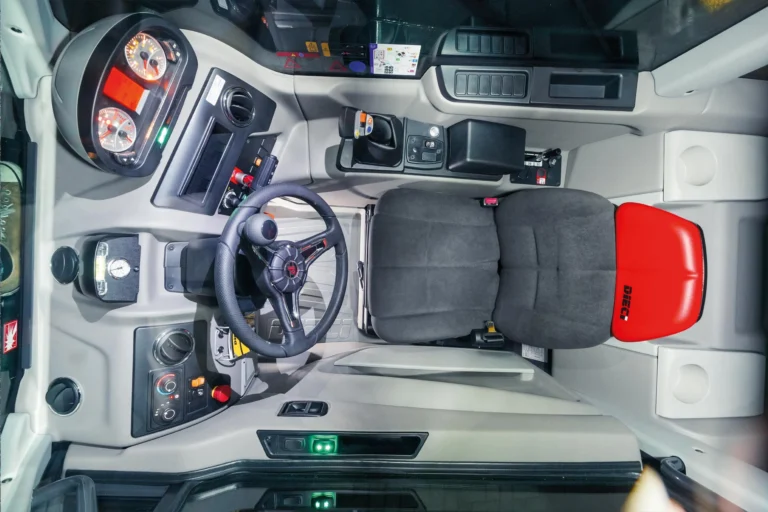
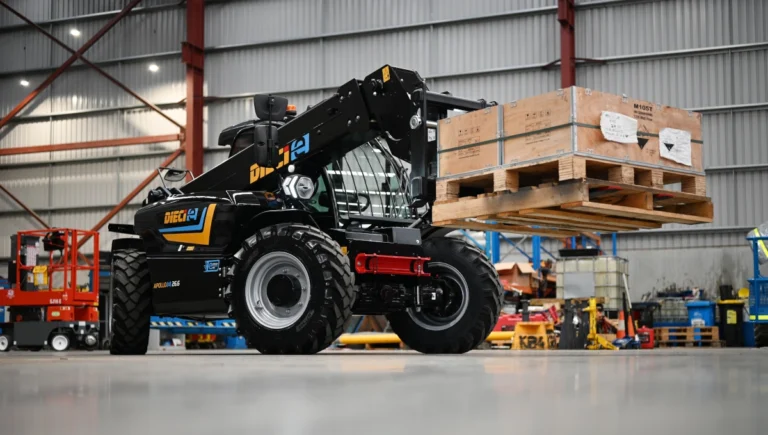
Have you ever wondered what those confusing diagrams in a telehandler cab actually mean?
Load charts aren’t just a safety formality. They directly impact your buying decision, operator safety, and site compliance. Misreading one could lead to tipping incidents, damaged loads, or even regulatory action.
This guide explains what load charts show, how to read them properly, and how to avoid the most common mistakes.
What Is a Telehandler Load Chart?
A load chart tells you exactly how much weight a telehandler can safely lift at different boom angles, heights, and extensions.
It considers:
- The base model and its rated capacity
- Boom extension and lift height
- Weight distribution and centre of gravity Attachment type and angle
It’s essentially the machine’s performance envelope. Step outside it, and you’re risking more than efficiency.
Load Charts Matter to Buyers
Most buyers focus on headline specs: max capacity and max height. But those two numbers rarely apply at the same time.
A machine rated for 4 tonnes may only lift 1 tonne at full extension. The load chart tells you exactly where the limits are.
This helps you:
- Choose the right machine for your job
- Understand derating caused by attachments
- Avoid overspecifying or underspecifying
- Support operator safety and site compliance
Quick Guide: How to Read a Load Chart
Here’s what to look for:
- Axes: Usually height on the vertical axis and reach (or boom extension) on the horizontal axis.
- Colour zones or data blocks: These show the max safe load at each position.
- Attachment-specific charts: Forks, buckets, jibs — each changes the load distribution.
- Boom angle indicators: Useful for operators when placing loads at height.
Tip: Never assume the load chart in the manual is identical to the one for your configured machine. Always use the chart for your exact spec.
Common Mistakes That Lead to Safety Risks
Some of the most frequent (and avoidable) load chart errors include:
- Using the wrong chart for the attachment
- Ignoring reduced capacity at maximum extension
- Assuming max lift applies at any boom angle
- Not displaying the chart clearly in the cab
- Failing to train operators in chart use
Every WHS inspector knows these. So should you.
How Load Charts Affect Buying Decisions
Understanding load charts helps prevent two critical issues:
- Underspecifying — Choosing a machine that can’t perform under real-world conditions
- Overspecifying — Buying more machine than you need, wasting budget and space
This is especially true when attachments come into play. Buckets, man baskets and jibs all reduce the machine’s rated capacity.
Buying without this insight? That’s a gamble.
How Dieci Makes It Easier to Get It Right
Every Dieci telehandler comes with machine-specific load charts and operator training support.
- Charts account for real-world configurations and common attachments
- Machines feature in-cab load chart displays for compliance
- The Dieci sales team help customers assess load handling needs before sale
We take the guesswork out of safe lifting.
Need Help Matching a Load Chart to Your Site?
We can help you interpret your lifting needs, match them to the right model, and ensure every machine is working within spec.